

I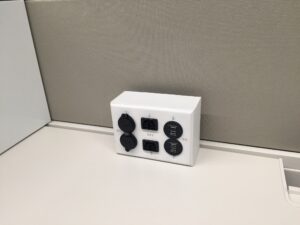 f you’ve noticed an unusual-looking box on a desk at The Alliance Center—one with a surprising number of connection ports—you’ve found an artifact of an experiment from the building’s earlier days as a Living Laboratory.
In 2014, the team here started asking questions about the devices that power our work lives—laptops, monitors, phones, LED lights. These devices all run natively on direct current (DC) electricity. But buildings have been wired for alternating current (AC) since the 1880s. Every time a device converts AC to DC, energy is lost; roughly 13 percent in a typical office building. Solar panels and batteries produce DC naturally. What if we stopped converting, and just delivered DC directly? Could we reduce energy waste, lower carbon emissions, and help lead the commercial building sector—which consumes roughly half of all U.S. electricity—into a cleaner future?
The Alliance Center decided to find out if it could be done.
In 2016, with permits secured from the City and County of Denver, the team launched the dc Project: a retrofit of our six-story, 40,000-square-foot historic LoDo building with a working DC microgrid. A 25.7kW rooftop solar array paired with an 84kWh lithium-ion battery bank delivered DC power directly to the lights and plug loads in Suite 100. Construction partner PVI led the installation. It was believed to be the first project of its kind in an existing commercial building anywhere in the world.
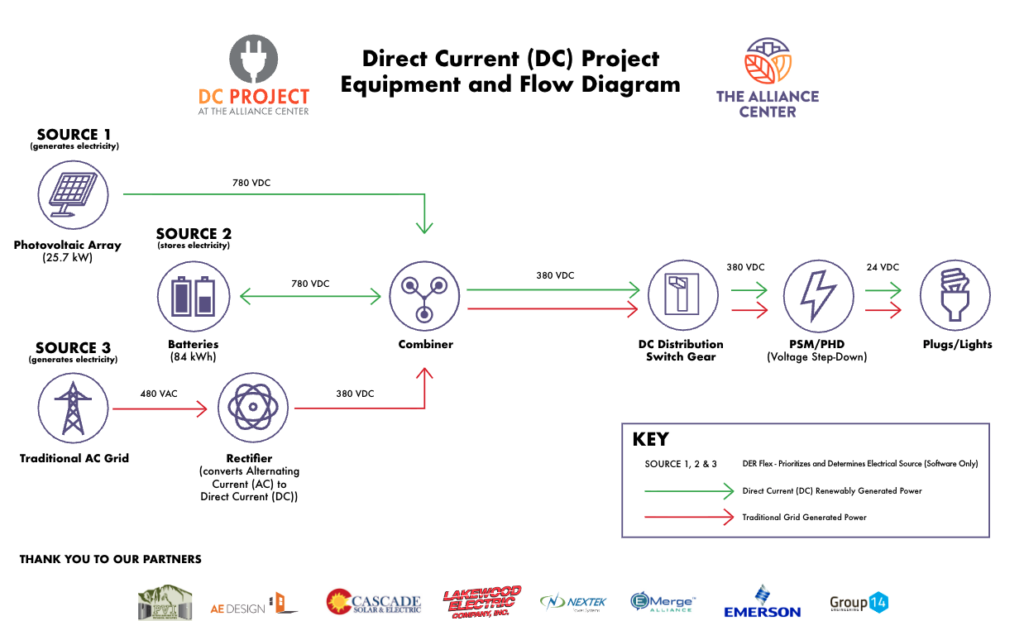
The project was designed to generate real-world data, share findings publicly, and help other buildings understand what DC transmission could actually deliver. When the team needed a consumer-facing connection box to bring DC power to desks, none existed off the shelf. So they built one—accommodating three voltage levels and three connection types, because the industry hadn’t yet agreed on standards. That box is the one you may have seen.
The field data generated here contributed to research at the National Renewable Energy Lab and Colorado State University, and helped shape a DOE-funded design tool for future DC projects.
Then, in 2018, the vendor supplying the microgrid’s core hardware and software went bankrupt—while the system was still being commissioned. With proprietary controls that no other vendor could support without prohibitive cost, the project stopped generating the data it was designed to produce. After years of exploring reactivation, the team ultimately concluded that the investment required couldn’t be justified by the demonstration benefits remaining. Batteries were returned to the manufacturer, equipment was donated to Colorado State University, and in late 2022 the rooftop solar array was reconnected to the grid under a standard interconnect agreement. Here’s a link to the final technical report , released by the National Renewable Energy Laboratory and Lawrence Berkeley National Laboratory in May 2021.
The project lasted for eight years. A lot of fabrication, permitting, research, and problem-solving. The dc Project helped move a field-wide conversation from theory to demonstration—contributing to academic research, educating code officials and engineers, and showing that a different approach to building energy is real and worth pursuing. The lessons we learned were to prioritize open-source controls, design for DC from the start rather than retrofitting, and ensure no single vendor can take a project down.
Those connection boxes still sit on desks here as an intentional reminder that innovation requires the willingness to try things that don’t always work out, and that what’s learned in the attempt belongs to everyone who follows.